


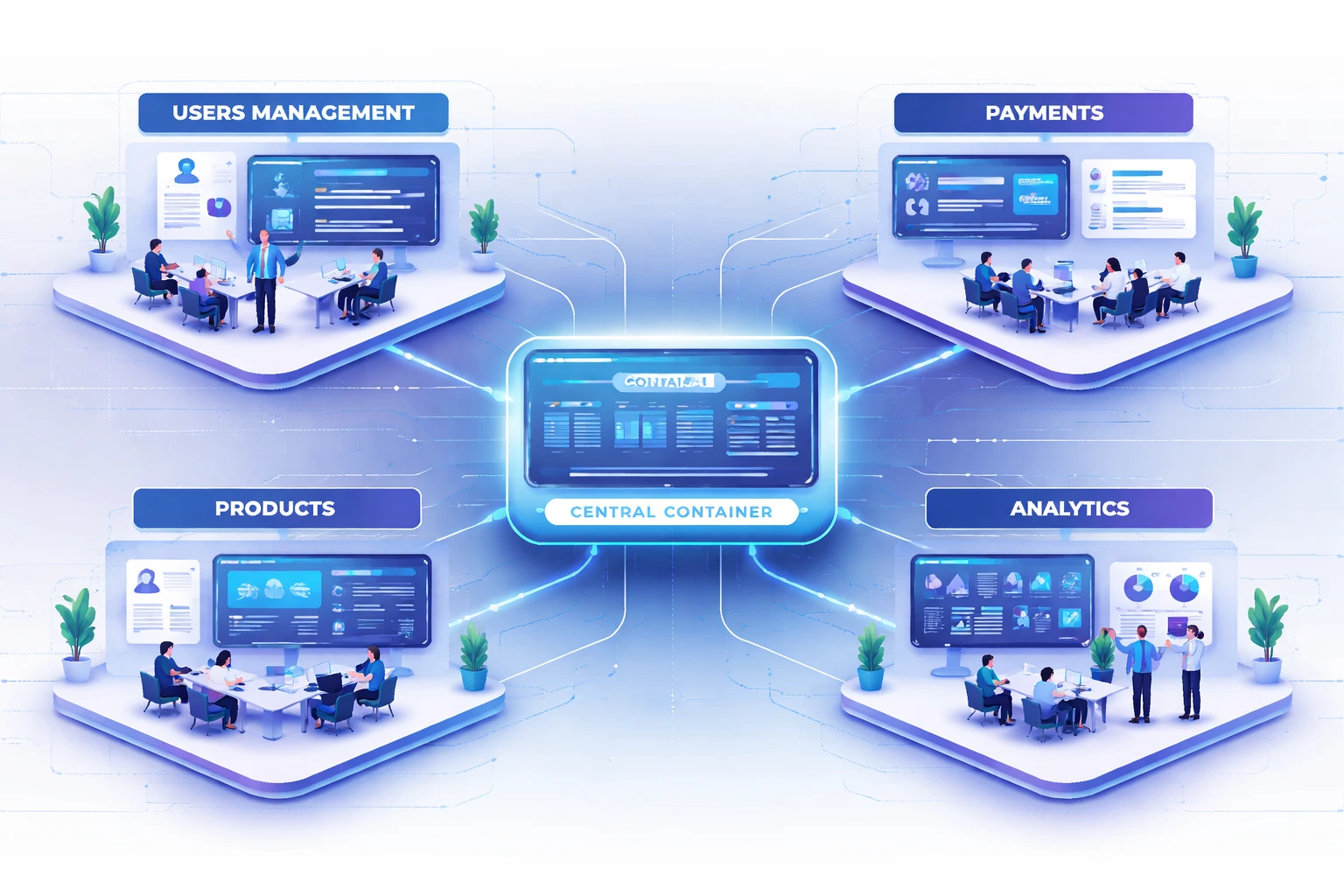
As of 2026, we have reached an inflection point for frontend development. The traditional notion of an application as a ‘dashboard or landing page’ has evolved to that of being a ‘complete platform that supports numerous features and user flows with multiple engineering teams developing simultaneously.’
According to recent findings on frontend architecture, over 68% of enterprise teams report that their greatest pain point is the frontend codebase rather than the backend (a significant departure from just 5 years ago).
Additionally, one of the biggest hurdles facing our teams today is ‘coordination.’ Teams no longer simply develop new features. Teams are now developing competing feature sets with the goal of intercepting other feature set developers; therefore, the coordination of competing code will result in slower pace of innovation and higher rates of failure/defects.
What are Micro-frontend and why will they be applicable in 2026?
Micro-frontend is an architectural style developed as a result of breaking a large frontend down into smaller, fully functional, independently deployable segments. Each team has complete ownership of their own segment (called ‘micro-frontend’) and can therefore build, deploy, and scale it independently of one another.
Micro-frontend is evolving out of the micro-service architecture; applied to the frontend layer, where the majority of the development complexity is occurring the fastest over the past few years.
As of 2026, for larger teams this will no longer be an option. A global survey illustrates that organizations utilizing 10+ frontend engineers are 3 times more likely to implement the micro-frontend architecture when compared to smaller teams.
The Problem with Monolithic Frontends
When applications were small, monolithic frontends were highly suitable for development with limited numbers of developers and teams. Having everything in one code base allowed developers to build applications quickly and easily during initial phases of application creation.
The problem with this simplicity arises when applications become larger in size. As such, teams are now experiencing issues including long build times, conflicting code, and unpredictable deployments as their application continues to scale.
In many cases for larger applications (or systems), build time can be greater than 20 minutes. Additionally, making a minor UI change can cause the entire frontend of an application to be rebuilt. Both of these issues cause slow iterations in development and aggravation for developers.
One of the biggest issues with monolithic frontends is that they create “hidden” dependencies where making changes to one module (or part of the entire application) may result in breaking something else without the developer being aware of it, thus making it difficult for an engineer to feel safe deploying their changes or testing their code for correctness prior to deployment.
How Micro-Frontend Architecture Works
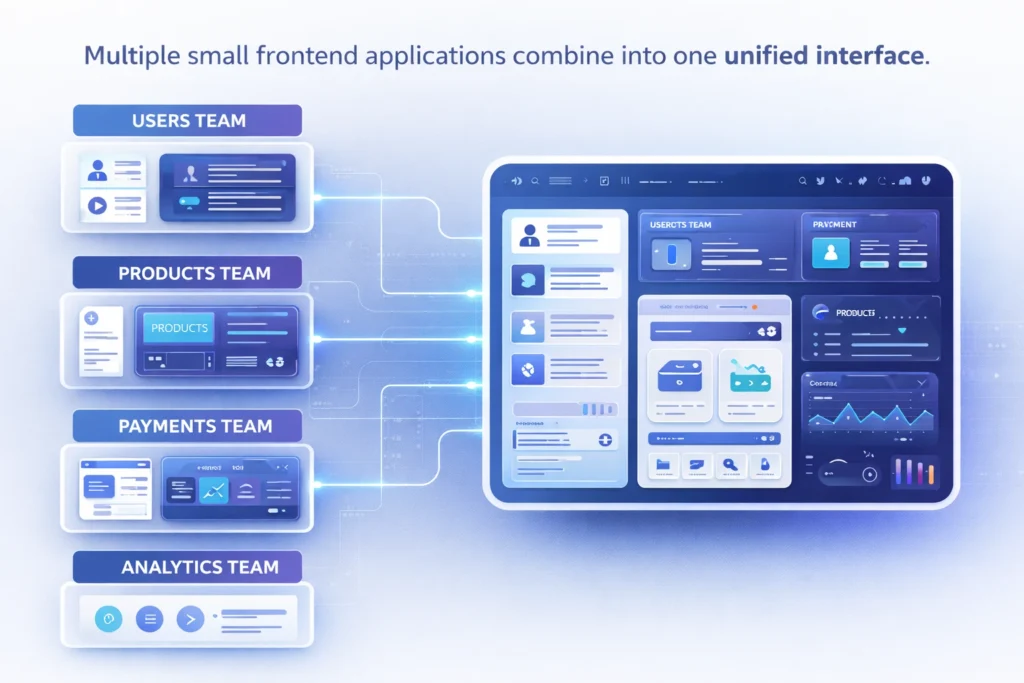
Micro-frontend architecture solves these problems by breaking the frontend out into individual pieces while at the same time preserving the overall user experience of the application. Rather than having one large application, you can now have several small applications which all work together as a cohesive whole.
In addition, this separation of the frontend application into several smaller units allows each development team to work independently without impacting each other which is critical to scaling application development effectively.
The heart of this system is the base container application which dynamically loads the various remote modules to create one application on the user’s behalf. Each of these modules represents a remote application owned by a specific development team.
Container and Remote Applications Explained
The container app acts as the backbone of the application. It handles routing, layout, and orchestrates how different parts of the UI are rendered on the screen.
Remote apps are independent frontend modules that plug into the container. They can be built using different frameworks and deployed without affecting the entire system.
This architecture allows teams to release updates independently, which significantly reduces deployment risk. Companies adopting this model report up to 40% fewer production incidents during releases.
Module Federation vs Import Maps: Choosing the Right Approach
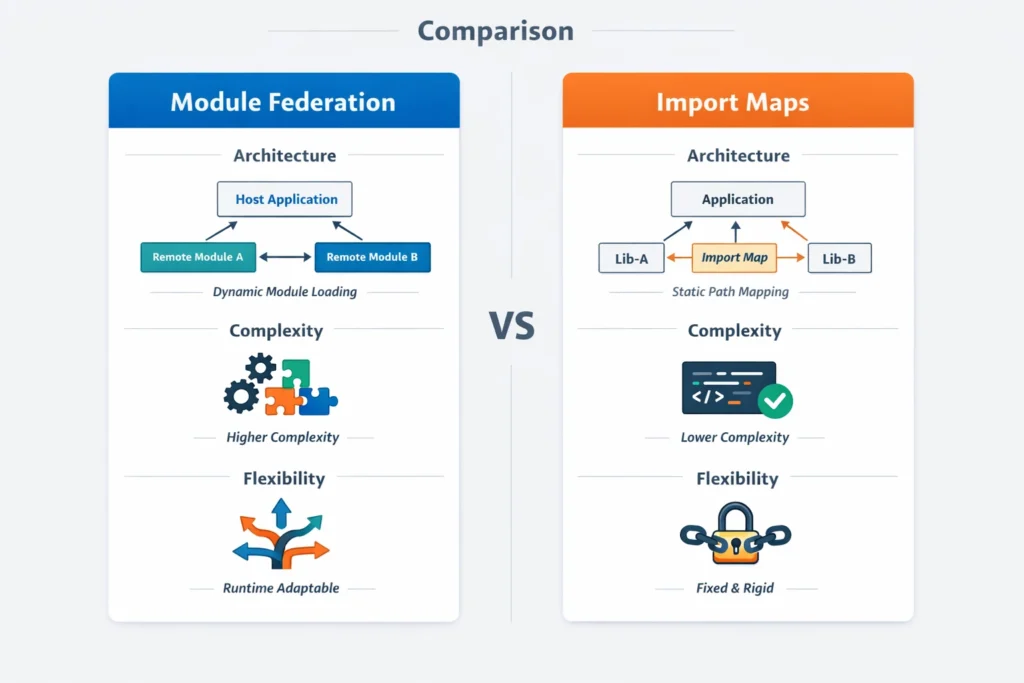
As micro frontends continue to gain traction, developers are looking for more efficient ways of implementing them. Two options appear likely to be the most effective methods of implementation by 2026: Module Federation and Import Maps. Both of these solutions have their strengths and weaknesses, depending on the specific use case.
Module Federation (Webpack 5)
Module Federation allows multiple applications to share code-ranging from dynamically loaded components to modules — without requiring the entire system to be rebuilt. This is a common approach in building large applications with React, as it supports shared dependencies and dynamic loading.
Companies that utilize Module Federation have reported reductions in their bundle sizes of as much as 30% because of shared libraries; however, a careful strategy is required to effectively manage dependencies within an organization to prevent conflicts.
Import Maps
Import Maps represent a lighter-weight, browser native approach to implementing micro frontends. Import Maps enable developers to define how modules are resolved within the browser, thereby reducing the amount of time that they have to rely on complex and cumbersome build systems.
Many developers find Import Maps easier to maintain, understand, and support when building simple applications; however, other than the inherent limitations of not yet fully supporting advanced use cases, Import Maps might be a better option for teams that are looking for maintainability, rather than dynamic complexity.
Benefits of Micro-Frontends for Large Teams
Micro-frontends enable frontend teams to reach new heights of scale by providing the flexibility to increase speed without increased need for coordination among teams.
One of the major benefits of using micro-frontends is that they allow teams to deploy their own features independently. Developers no longer need to wait on a global release cycle to deploy their features.
As a result, organizations experience measurable improvements, such as:
- 40% faster release cycles
- 25% increased developer efficiency
- 30% reduced failure rates for deployments
Additionally, micro-frontends grant developers greater autonomy over the work they perform. Each developer is able to concentrate fully on his/her own area of expertise and is no longer required to worry about whether or not he/she will affect another part of the application.
The Challenges You Should Not Ignore
Micro Frontends provide many benefits, but come with tradeoffs as well. When deploying many applications, there is operational complexity that will require your team to manage.
One of the largest areas of concern is performance, as loading multiple remote apps will increase their initial load time unless you optimize them properly.
Also, each team having its own design system could lead to inconsistencies between the look and feel of the applications.
Finally, debugging will become more complicated because some of the errors may be found across multiple applications, making them more difficult to locate and fix.
Real-World Adoption and Industry Trends
Micro-frontends have moved far beyond experimentation and are now a proven, production-grade architecture adopted by some of the world’s largest digital platforms. What started as an extension of microservices has become a strategic approach for scaling frontend teams, products, and user experiences.
Today, companies like Spotify, IKEA, Zalando, and DAZN actively use micro-frontend architectures to enable independent team ownership, faster deployments, and continuous delivery at scale. These organizations manage dozens of teams working in parallel, something that would be extremely difficult with a monolithic frontend.
Industry data further reinforces this shift. According to recent frontend architecture and DevOps reports:
- 55%+ of enterprise frontends are expected to adopt micro-frontends by 2027, making it one of the fastest-growing architectural patterns
- Organizations with 10+ frontend developers are 3x more likely to implement micro-frontends
- Teams adopting micro-frontends report 30–50% faster feature delivery cycles due to reduced cross-team dependencies
One of the biggest drivers behind this adoption is the demand for continuous deployment at scale. Modern digital products are no longer updated weekly or monthly. Many large platforms now deploy multiple times per day, and micro-frontends make this possible by allowing:
- Independent releases without full application redeployments
- Parallel development across multiple teams
- Faster rollback and reduced blast radius during failures
Another key trend is the rise of hybrid frontend stacks. With micro-frontends, organizations are no longer locked into a single framework. Teams can combine technologies like React, Vue, or even legacy systems within the same application, enabling gradual migrations instead of risky full rewrites.
From a business perspective, companies adopting micro-frontends consistently report:
- Shorter time-to-market for new features
- Improved system resilience, as failures are isolated to smaller modules
- Higher developer productivity and ownership, leading to better code quality
As frontend complexity continues to grow with AI-driven interfaces, personalization, and real-time data, micro-frontends are becoming less of a “trend” and more of a necessary evolution in architecture.
In the coming years, the competitive advantage will not just come from building features—but from how quickly and safely teams can ship them. Micro-frontends are emerging as a key enabler of that speed.
When to Use Micro-Frontends
Micro-frontends are best employed as part of the software development process when your application has evolved to the point of having significant(spatially and temporally) complexity. A smaller web project with only a limited number of developers would not normally benefit from a micro-frontend approach.
That being said, once your development team reaches greater than 5 to 6 developers and begins rapidly scaling your application, utilising a micro-frontend architecture will become evident.
Organisations with remote teams, or organisations who dramatically expand the number of product lines or who deploy multiple times throughout the day will realize tremendous value from implementing micro-frontends for their applications.
The Future of Frontend Architecture in 2026 and Beyond
Frontend architecture is progressing toward modular and distributed architecture that can scale without problems. Monoliths are being phased out to create more nimble architectures that allow for independent development.
With the emergence of edge computing, WebAssembly, and AI-driven UI creation, the frontend layer will become much more dynamic in the next few years.
Micro-frontends will be at the forefront of this shift, providing teams with the ability to create quickly and innovate without limitations.
Conclusion: Build Faster Without Breaking Everything
Micro-frontends provide a powerful solution for scaling frontend development in modern applications. They allow teams to work independently, deploy faster, and reduce the risks associated with large codebases.
While they introduce new challenges, the long-term benefits make them a valuable investment for growing organizations.
In 2026, the question is no longer whether your frontend will become complex. It is whether your architecture is ready to handle that complexity without slowing you down.